Paddington Bear’s First Concert

Concert Program:
Paddington Bear's First Concert

Classical Symphony, op.25 (Symphony No.1) – Serge Prokofiev

Paddington Bear’s First Concert – Herbert Chappell

“Paddington Bear’s First Concert” made possible by a grant from the IMPACT Youth Council of the Ashland County Community Foundation. https://ashlandforgood.org/impact-youth-council/

On behalf of the Board of Directors of the Ashland Symphony Orchestra, welcome to our 56th season! I feel such warmth and pride that our small town supports a professional symphony orchestra. The ASO is truly a gem of our community, sharing the joy of orchestral music with people of all ages and backgrounds. Our Grammy-award winning Music Director and Conductor Michael Repper and the talented professional musicians of the ASO have created another incredible season for your enjoyment. We are eager for you to hear the beautiful, powerful, soul-filling music that they have prepared for you. Meanwhile, our Executive Director Martha Buckner continues to provide innovative opportunities, such as the ASO Fan Club, that support the development of young musicians throughout Ashland County and beyond. I am deeply thankful to our musicians, staff, board members, and supporters for making this season possible. And to our patrons, please know that your presence at ASO performances means so much! Whether you are joining us for a pops concert, a concert in our Saturday night subscription series, or one of our concerts presented especially for young people, your attendance lifts up the ASO. Thank you for choosing to spend your time with us!

Diane Bonfiglio, Ph.D.
President, ASO Board of Directors

Dear Friends,

Welcome to the Ashland Symphony Orchestra’s 2025–2026 season! It is a joy and an honor to continue this musical journey with you as your Music Director.

This year, we invite you to come aboard for a season of imagination, discovery, and connection—a musical journey that takes flight and carries us to every corner of the world. Like a great plane ride full of wonder and anticipation, each concert is a stop on a global adventure. You’ll hear the brilliance of Beethoven, the soul of Coleridge-Taylor, the energy of Jessie Montgomery, the lyricism of Schubert, the fervor of Borodin, and so much more. These works, drawn from across time and cultures, remind us that music is a language that speaks to the heart.

One of the highlights of our season is a groundbreaking spring concert that reflects our deep commitment to community and innovation. In partnership with Goldberry’s Coffee, we’ll combine music with global storytelling and curated coffee tastings—an immersive, sensory celebration that brings people together in a truly unique way. This collaboration is one of many ways we continue to grow as a vibrant cultural hub in Ashland and beyond.

Whether you’ve been with us for years or are joining us for the first time, your presence is what gives our music life. Thank you for supporting live orchestral music and for being a vital part of our ASO family.

I look forward to sharing the season with you—and to welcoming you on this musical adventure.

With warmest regards,
Michael Repper
Music Director
Ashland Symphony Orchestra

Executive Director’s Message

I am thrilled to have you join us on our ‘round the world tour of classical music! From the old masters to the new trailblazing composers, the musicians of the ASO will bring the pieces to life.

Hanna Strickland, ASO Administrative Assistant, and I had great fun creating the theme of “Your Passport to Great Music” and naming the concerts, and we hope you enjoy the journey.

The $100,000 challenge set forth by Bob and Jan Archer was met and they have established a new $1 million endowment to benefit the ASO. My challenge to you is to invite friends and family to each of the concerts this season.

Sit back, relax, and enjoy the flight!

Martha Buckner, Executive Director

Conductor Michael Repper’s work spans six continents. In 2023, he became the youngest North American conductor to win a Grammy® Award in Best Orchestral Performance. He has an international reputation for engaging and exciting audiences of all spectrums, and for promoting new and diverse musical talents.

Repper is currently the Music Director of the Ashland Symphony Orchestra, Mid-Atlantic Symphony Orchestra, and the Northern Neck Orchestra of Virginia.  He recently concluded tenures as Music Director of the New York Youth Symphony at Carnegie Hall, and as Principal Conductor of Sinfonía por el Perú, the elite youth orchestras and choruses of one of South America’s most versatile social impact music programs. Repper was the Baltimore Symphony Orchestra Conducting Fellow for two seasons, and he served as the BSO’s New Music Consultant. Recognizing his success at these ensembles, and his growing profile as a guest conductor all over the world, Repper was awarded a Solti Foundation US Career Assistance Award in 2020, 2021, 2022, and 2023.

His album with the New York Youth Symphony, which features debut recordings of works by Florence Price, Jessie Montgomery, and Valerie Coleman, achieved widespread critical acclaim, reached #1 on the Billboard Chart, and won a Grammy® Award, marking the first time a youth orchestra achieved this milestone.

Repper has collaborated on large-scale productions of symphonic and theatrical works with the Weill Music Institute at Carnegie Hall, the Chicago Symphony Orchestra, Ravinia Festival, Peabody Institute of Music, and the New School of Music, among others. An avid pianist, he regularly performs as a soloist alongside his orchestras.

​Alongside the standard repertoire, Repper is especially invested in programming new music and showcasing fresh talent. His ensembles have performed dozens of world premieres and pursued innovative commissions, as well as a variety of Carnegie Hall premieres from established and emerging composers.

His experience with choruses has been recognized with significant positions, including his tenure as the Music Director at the Baltimore Basilica, the first Catholic Cathedral in the United States. Internationally, Repper has performed with highly regarded ensembles and in the world’s greatest venues, including the São Paulo Symphony, and at the Palau de la Musica in Barcelona, Carnegie Hall, and others.

His discography includes the aforementioned album of music with the New York Youth Symphony, alongside an album with the Grammy®-Nominated Metropolis Ensemble and Grammy®-Winning Brooklyn Youth Chorus (“Musical America”), and several with the Peabody Institute as an Assistant Conductor. With the New York Youth Symphony during the Coronavirus pandemic, he was one of the first to pioneer the practice of distanced orchestral performance videos, and he made two performance appearances on CNN, the final one with Platinum-Artist Billy Ray Cyrus.

Repper complements his work with professional orchestras with a firm commitment to education, and travels worldwide to work with ensembles of young musicians. As Artistic Director of the Chamber Music Society of Maryland, he ushered in a slate of innovative educational programming, such as the Reinecke Youth Chamber Music Scholarship and Fellowship Program. He has conducted several masterclasses for orchestras from all over the United States on behalf of the New York Philharmonic, and conducts side-by-side and educational concerts with major orchestras, including the Baltimore Symphony, the Colorado Symphony, and the Sarasota Orchestra.

Repper’s most influential conducting mentors are Marin Alsop and the late Gustav Meier. He believes that a conductor’s main role is to connect people and to use performance as a vehicle for positive change. He aims to promote a diverse and inclusive future for the arts, and to pay forward the passion for community that his mentors demonstrated to him.

PROKOFIEV, Serge: Classical Symphony, op.25 (Symphony No.1)

  1. Allegro con brio

III. Gavotte: Non troppo allegro

Instrumentation: flutes, oboes, clarinets, bassoons, horns, trumpets, timpani, and strings

Duration: 8 minutes

Prokofiev and Dmitri Shostakovich are the two composers who stood above the rest of those who labored during the years of the Soviet Union.  Unlike Shostakovich, however, Prokofiev enjoyed part of his career living and composing in the West, returning to the USSR in 1936 voluntarily.  Like his compatriot, he must be counted as one of the great composers of the twentieth century, although unlike Shostakovich, his direct influence on composers outside of the Soviet sphere was minimal.  He was a virtuoso pianist, but who also composed from the beginning, graduating from the St. Petersburg Conservatory shortly before World War I.  His musical style was based in the Russian romantic tradition, but he established early on a personal idiom that was characterized by pungent dissonance, soaring lyrical melodies, a facile manipulation of motoric rhythms, and kaleidoscopic harmonic changes.  Part and parcel of his musical personality was an acerbic appreciation of satire, parody, and even the grotesque.

Although he travelled widely early on, he returned to the Soviet Union from time to time for extensive concertizing; his works were performed frequently there, and he always kept his Soviet passport.  He was never a political naïf regarding the life of artists under that political system, and it must be surmised that his eventual removal to the USSR was made with open eyes.   His musical language had been gradually moving to a simpler, more accessible style—a necessary condition for artists who wished to serve a collectivist state and appeal to the masses.  So, when he and his family arrived in Russia in 1936, he adapted readily to political requirements by composing works that addressed the necessary content of “socialist realism.”   This primarily meant patriotic subjects, in a traditional musical style, that served political ends.

Never really playing his political cards, he managed to survive the incredibly difficult times during the 1940s by adroit artistic gamesmanship with the harshly repressive Stalinist state.  He never joined the Communist Party, and made few public statements.  He struggled to survive, maintain his artistic integrity and continue composing in an authentically personal style.  But, alas, the difficulties of the extreme, repressive measures beginning in 1948 ultimately got the best of him.  His death on 5 March 1953 ironically garnered little recognition—Joseph Stalin’s demise on the same date preëmpted the stage.

His “Classical” symphony is a charming example of “what if.”  That is to say, what if one of the great twentieth-century modernists had decided to compose a symphony using many of the essential characteristics of Haydn and Mozart, while also employing his own ideas of melody and harmony?  Prokofiev’s unique answer has long been part of the standard orchestral repertoire, owing to its adroit, successful combination of what would seem to be antithetical elements.  Written in the summer of 1917, while the composer was a student at the St. Petersburg Conservatory, it is cast in the traditional four movements of the classic model:  fast movement in sonata form, slower movement, dance movement, and fast concluding movement.

By the time of World War I there had arisen in musical composition a counter approach to the dense complexities of late romantic music, and the equally dense dissonance of the works of those who pushed past the limits of tonality.  It sought solutions in an opposite approach that featured simplicity of harmony, melody, and rhythm, along with an adaptive reuse of the forms of times past.  Dubbed “neoclassicism” by music scholars, it became an important way of composing during the period between the world wars.   The preëminent composer of the century, Stravinsky, adopted these principles around 1919, and stayed with them for three decades.  Other luminaries dabbled in the techniques, but went on in other directions.

Prokofiev’s Symphony is considered perhaps the earliest foray into neoclassicism, or at least a harbinger, but Prokofiev later dismissed the stylistic significance of it in terms of his own development as simply “an experiment.”   Indeed, he never again wrote anything quite like it, and quickly moved forward into his familiar modern, but personal, style.   It’s important to keep in mind throughout this work that the key word is “experiment,” for in its simplicity, it’s far more “classical” than “neo.”  Most works of other composers more committed to so-called neo-classicism used the older elements somewhat more sparingly, and employed newer approaches with commitment.

The first movement is about as simple as one can get: almost all of the notes are either eighth notes or quarter notes, the rhythms are straightforward and clearly right out of the middle of the eighteenth century.  Even the melodic lines are definitely “in a clear key,” but with one decided exception:  A lifelong proclivity of Prokofiev was to write an apparently simple diatonic melody, but jumping around from distant chord to distant chord in a most refreshing manner, only to land right back on the tonic chord just in time!  And thus it is here.   The first theme, a busy, dynamic one, is heard right at the beginning.  The clear, mincing second theme, is a delicate affair, composed of soft, short notes that drop a whole two octaves, accompanied by the bassoon.  Some busy closing material takes us to the end of the exposition—all in a “textbook” sonata form.   Lots of surprising changes of harmony clearly tell us that we’re in the development, and the recap is as straightforward and as easy to follow was one could wish.

During the classical period the third movement was almost always a minuet, only later did the likes of Beethoven speed it up to become a scherzo—but almost always in triple meter.  But here, our stalwart—and always sly—Prokofiev reaches back one more historical period (to the baroque) and selects a common dance from that time that is in two—not three—beats to the bar.  The gavotte traditionally has the accent on beat two, rather than the conventional downbeat of one, so listen for trills, accents, and other ways of emphasizing beat two.   Prokofiev knew his historical dances.

This effervescent, diminutive symphony may have been an “experiment,” but the positive results have been clear for a century, now.

–Wm. E. Runyan

© 2016 William E. Runyan
CHAPPELL, Herbert: Paddington Bear’s First Concert

Instrumentation: flutes, oboes, clarinets, bassoons, horns, trumpets, timpani, percussion, harp, strings, and narrators

Duration: 30 minutes

In the autumn of 1974 Michael Bond, the author of the Paddington Bear stories, asked me to write a tune for a short cartoon-film. This I was delighted to do, for I had long been a devoted admirer of Paddington. The film turned out well and so we sat down and wrote a stage musical about the famous bear, completing it in time for Christmas. The musical was first performed in London at the Duke of York’s Theatre and has since become very popular. Similarly, over the years, the original five-minute cartoon film has led to some six dozen others, plus several television ‘specials’. It was therefore inevitable that sooner or later Paddington would invade the world of classical music, so we wrote PADDINGTON IN CONCERT for story-teller and orchestra. For those interested in such matters, all the musical material grows out of the first two bars of the Paddington theme – a step-wise climb of a fourth followed by a drop of a seventh.

I conducted the Premiere with the London Concert Orchestra on 3 January 1986 at the Barbican – or Bearbican as the building became known thereafter; ‘Teddy Bears Concerts’ where thousands of children bring their furry friends, have become immensely popular.

Any moment now we shall no doubt write a Paddington son-et-lumière and a Paddington underwater ballet. Meanwhile, I have made a piano transcription for occasions when you have no symphony orchestra handy.

– Herbert Chappell

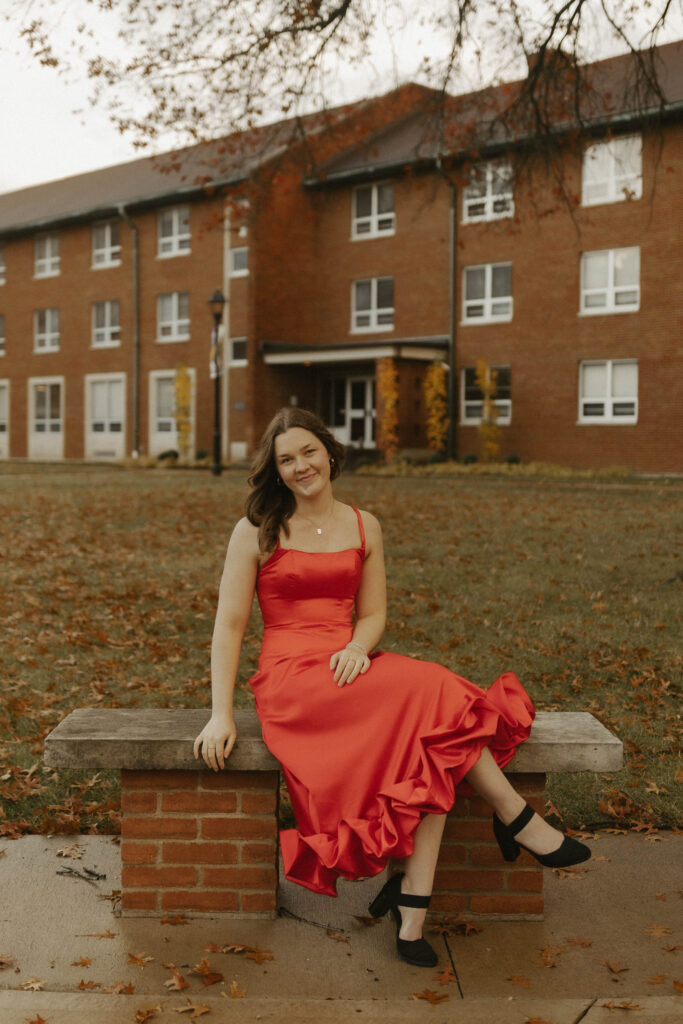
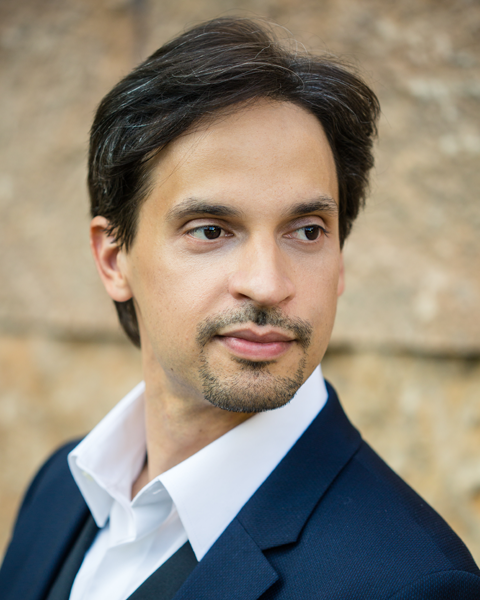
Lauren Gulden is a journalism senior at Ashland University with a big heart for the arts. She has been involved in theatre for many years and used to play the violin, herself! She is thankful for this very sweet opportunity.
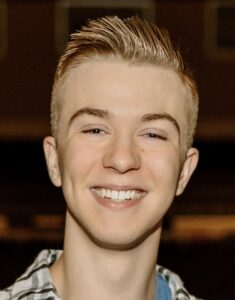


Owen Radebaugh is a junior nursing major who has been involved with various theater and music groups affiliated with AU. He is a three-year member of the AU University choir, a two-year member of AU chamber singers and Alpha Psi Omega theater Honor society, and was involved in the 2025 AU musical, The Sound of Music, as Rolf. He is excited to be involved with the Ashland Symphony Orchestra and hopes you enjoy the show!
Violin I

Samuel Rotberg, Concertmaster
     James E. Thomas Endowed Chair

Jane Reed
Kia-Hui Tan
Kristen van Dyck
Krista Solars
Lily Kostraba

Violin II

Mary Kettering, Principal
Ania Kolodey
Wanda Sobieska
Michael Sieberg

Viola

Carol Ross, Principal
Joshua Bowman
Colin Henley
Nik Repka

Cello

Jeffrey Singler, Principal
Lindsay Brown
Matthew Rhee
Rosa Balderrama

Bass

Bryan Thomas, Principal
Jeff Weeks

Flute

Carla Colon, Principal
Carol Oberholtzer
John H. Landrum Endowed Chair

Oboe

Axl Pons, Principal
Melanie Garcia

Clarinet

Thomas Reed, Principal
Joe Minnochi

Bassoon

Ian Hoy, Principal
Luis Torres

Horn

Laura Makara, Principal
Timothy Stewart

Trumpet

Kenneth Holzworth, Principal
Ted Clark

Timpani

Kirk Georgia, Principal

Percussion

Torrell Moss, Principal
Kirk Georgia

Timpani

Rebekah Hou, Principal

The Ashland Symphony Orchestra thanks

Our ushers and volunteers

Ashland High School staff for technical support

Ashland City Schools for its continued support of the Arts

Peter Slade for recording the opening announcement

Hanna Strickland, Administrative Assistant

Seth Morrison, Stage Manager

Bryce Bishop, Assistant Stage Manager

Deken Foster, Assistant Stage Manager

Please silence all electronic devices.
No flash photography or audio/visual recording permitted.
No food or drink permitted in the Robert M. & Janet L. Archer Auditorium.

Thank you for your cooperation.

The individuals and associations listed on this page, by their support of the orchestra’s operating fund, make possible the continuance of the Ashland Symphony Orchestra. Additional support is needed and will be most welcome at any time throughout the year. If there is an error, please notify the office. Donations listed as of 03/13/2026.

Make Your Giving Memorable

Celebrate A Birthday! Welcome A New Neighbor! Honor A Memory! Celebrate A Promotion!

The Ashland Symphony will recognize the people or events in your life with a letter that you have donated in their honor to the Ashland Symphony Orchestra. Please send us that person’s name, address and the event along with your donation and we will send a personalized note acknowledging your thoughtfulness along with the printed celebration text in the upcoming program. Call 419-289-5115 for more information.

‡Sponsor – sponsorships are still available for this season. Call 419-289-5115.
*Additional gift given to the Change for Music Education Campaign
Pacesetters – patrons who pledged on or before July 31, 2023 are indicated in bold.
Name in italics – increased pledge by at least 10%
NAME IN ALL CAPS – increased pledge to move up to a new giving level

Sustainers’ Circle $5,000 and up

Robert M. and Janet L. Archer‡
Ashla
nd County Community Foundation
Ashland University, in-kind support
ASO Podium Endowment Fund in Honor of Maestro Arie Lipsky est. 2018
The Dean and Joan Bartosic Fund (ACCF)
STAN AND DIANA BRECHBUHLER
Jim and Barb Chandler‡
Hugo H. and Mabel B. Young Foundation
Vicky Lippert
Loudonville Theatre and Arts Committee
Ohio Arts Council
The Elizabeth Pastor Fund (ACCF)
Samaritan Hospital Foundation‡
CHARLES AND PEGGY ULRICH

Encore Circle $3,000-$4,999

Anonymous
Campbell’s Corporation in honor of Kayla Selan
The John R. Donelson Fund (ACCF)
GRANDPA’S CHEESEBARN & SWEETIES CHOCOLATES‡
MICHAEL AND SEIKO HUPFER
David Kowalka
Susan Lime
SUELLEN McBURNEY
Loudonville Theatre & Arts Committee‡
ALAN AND MARJORIE POORMAN
Trinity Lutheran Church – Rybolt Fund‡
Dr. JoAnn Ford Watson*

Artists’ Circle $1,500-$2,999

Ashland City Schools‡
ASO Rev. John H. Landrum Memorial Endowed Chair for Flute 2 est. 2020
ASO Fund in Memorium of James E. Thomas est. 1999
Forrest Conrad
JAMES AND KRISTI CUTRIGHT
Denbow-Gasche Funeral Home & Crematory with onsite reception center‡
Thomas and Kristie Donelson‡
BETTI AND JOHN FRAAS
Barbara Glenn
CATHERINE HINER
Antonio and Karen Marallo
TOM AND MARY McNAULL*
OneTable Strategy
Ken Seidner and Dr. Lorena Surber
JOHN AND DANA SHERBURNE*
JOHN AND JEANIE SHULTZ
SPRENG-SMITH AGENCY‡
The J. Robert and Ruth L. Tipton Fund (ACCF)

Symphony Circle $1,000-$1,499

BCU Electric
Charles and Melody Barnes
The Dr. Beverly M. Bixler Fund (ACCF)
JEFF AND DIANE BONFIGLIO‡
MARTHA BUCKNER
ANGIE AND ADAM CIRONE
TIM AND ANNE COWEN
Jean Dierks
Germain Honda of College Hills
Ann K Guthrie: In honor of Arie Lipsky in gratitude for his leadership and talents.
The Ann K Guthrie Endowment Fund (ACCF)
Bud and Cuda Ingmand
Fred Lavender
The Nancy Kopp Fund (ACCF)
KEVIN AND CAROL OBERHOLTZER
Packaging Corporation of America
Peace Evangelical Lutheran Church‡
Dr. Jon Parrish Peede and Rev. Nancy Hollomon-Peede
PATRICIA PEREZ
JANE ROLAND
MICHAEL AND DEBORAH SULLIVAN

Maestro’s Circle $650-$999

Allan and Mary-Rose Andersen
Ron and Lisa Blackley
John and Lori Byron
The Billy M. Harris Fund (ACCF)
The Arie Lipsky Honorary Endowment Fund ℅ Ann Guthrie (ACCF)
Ron and Carolyn Marenchin‡
Bob and Jane Roblin*
Thomas and Jane Reed
Bill and Chris Strine
Dr. Stephen and Peggy Yoder*

President’s Circle $300-$649

Armodyne Computer Solutions‡
Ashland Dental Associates
ASO Harold Weller Music Education Endowment Fund est. 2019
Baker Bowman & Co.
Mary Ball
Sandra Bally
Bella’s 220
Doug and Susan Blake
Ted and Patricia Byerly
The Mary M. Case Memorial Fund (ACCF)
Charles River Laboratories
Coldwell Banker Ward Real Estate
Robert and Jan Cyders
Ray and Cherie Dever
Donald Earlenbaugh
Explore Ashland
MIMI AND JOHN FERNYAK
Fulmer Farms
The Dr. Alvin W. Garrett Fund (ACCF)
BETTY GARRETT
Ed and Karen Grose
Louise E. Hamel
GARY AND CHERYL HILDEBRAND
The Lawrence and Catherine Hiner Endowed Chair for Percussion (ACCF)
Jan W. and Sharon Howe
Irwin & Associates, CPA’s
Jersey Mike’s PS Subs LLC
Loretha Kline
Charles Kobb
TOM AND MARILYN KOOP
Ron and Barb Leddy
Mechanics Bank‡
Lighthouse Wealth Management
John and Donna Rae Maiken
Dann and Connie Marble
Mel McKeachie and Melody Snure
Miller’s Hawkins
Ken and Sheila Milligan
Larry and Diane Moretz
Pam and Mike Mowry
DAN AND LISA PETERSON
LANA M. POTTER
BARB QUEER
Brittany Reep ℅ ACCF Staff Grants Program
Ken Rinehart and Barb Schmidt-Rinehart
The William and Marlene Rose Fund (ACCF)
Gordon and Jane Ruggles
Deborah Seaman*
D.R. and C.L. Sedwick
Sarah Shepherd
Eric and Melissa Sponseller
Dorothy Stratton*
MICHAEL AND NANCY UDOLPH
Scott and Ann VanScoy
Cora Walker
Sterling Ward
The Dr. JoAnn Ford Watson Fund (ACCF)
Russell and Jan Weaver
Whitcomb & Hess CPAs & Financial Advisors
SUSAN WHITTED
Women’s Philharmonic Advocacy‡
Tim and Linda Workman

Concertmaster’s Circle $200-$299

Abbott Laboratories
Advantage Marketing, Inc.
Lucy Amsbaugh
Myron and Carolyn Amstutz
Ashland Noon Lions
Diane Bachtel
Buehler’s Fresh Foods – poinsettias
Polly Chandler (Amicae Per Annos)
Joe and Pat Denbow
Janice Eitelgeorge
Janice Fridline
John Giglio/In Tune Piano
Kelly Gregg (Fiel Foundation) in honor of Michael Repper
Susan Gregg and the late Dr. Robert Gregg
Jan Hamilton
Henry N. Hiner
Johnson Controls
LAW OFFICE OF ANDREW BUSH
Robert and Shirley Matz
R. Lee and Marianne Mowry
Roger Price
Tom and Diane Rohr
Robin Ryland
St. Matthew’s Episcopal Church
David and Marjorie Seiss
Ralph and Betty Jo Tomassi
Jenny Whitmore

Musicians’ Circle $100-$199

Anonymous
The Robert M. and Janet L. Archer Fund (ACCF)
Elizabeth Arnold
Ashland Musical Club
Tim and Laura Baker
John Bates
Jennifer Beckwith (Amicae Per Annos)
Patricia Saunders and Soren Brauner
Brethren Care Village
Suzanne Carruthers (Amicae Per Annos)
Barb Chandler (Amicae Per Annos)
Maryanne Chengelis
Madeline Cole
Freda Cook
Denny and Polly Davis
Cara Dziak/Rosewood Music Studio
Bonnie Graves
David and Debby Gray*
Robert Groenke
Gene and Jan Haberman
FRANCES HAMILTON
Tom and Chris Herron
Pamela Hinton
Stan and Joyce Hunt
Bob and Colleen Jackson
Unie Kettering
Barb Leddy (Amicae Per Annos)
Vicky Lipper (Amicae Per Annos)
Arie Lipsky
Josiah Mason
John and Laurie Maurer
Maurer Photography
Rita McElfresh (Amicae Per Annos)
Bonnie McGee (Amicae Per Annos)
Tom and Bonnie McGee
GAYLORD AND CAROL MEININGER
Mental Health and Recovery Board of Ashland County‡
Lucille Nuss (Amicae Per Annos)
PATRICIA PECK
Patricia Perez (Amicae Per Annos)
Lee and Dawn Peters
Karen Reaume
Michael Repper
Paul and Barbara Schantz
S. Kris Simpson
Jack and Nancy Smith
Rev. And Tom and Kitty Snyder
Glen and Judy Stewart
Brenda Uselton (Amicae Per Annos)
Dr. JoAnn Ford Watson (Amicae Per Annos)
Steven and Marla Willeke

Ensemble Circle $50-$99

Douglas and Rebecca Abel
Teresa Durbin-Ames and Larry Ames
Mary Ann Basinger in memory of Bob Gregg
Anne Beer (Amicae Per Annos)
Diana Brechbuhler (Amicae Per Annos)
Sheryl Budd (Amicae Per Annos)
Starr Dobush
Sandy Enderby (Amicae Per Annos)
Debby Gray (Amicae Per Annos)
Steve and Melanie Huber
Darcie Gilbert and Chris Koch*
Carl and Sandra Leedy
Connie Marble (Amicae Per Annos)
Deann Markle
Gayle Marie Martin (Amicae Per Annos)
Alice L. Metcalf
Nicole Paradis
Christopher and Linda Swanson
Nancy Udolph (Amicae Per Annos)


In 1997, Bob and Jan Archer established the first donor fund through the Ashland County Community Foundation to benefit the Ashland Symphony Orchestra. The ASO then partnered with the ACCF in 1999 and created the “Ashland Symphony Orchestra Fund in Memorium of James E. Thomas”. Since then, three new agency funds and fourteen additional donor advised or designated funds have been established! The Ashland County Community Foundation can assist you in creating a fund to benefit the Ashland Symphony Orchestra now or as part of your estate plan. For more information, call the Foundation at 419-281-4733.

Donations may be made to existing endowments at any time. Contact the Foundation for more information www.ashlandforgood.org.

*To contribute to these funds, please send donation to Ashland Symphony Orchestra, 401 College Ave., Ashland, OH 44805.

The Ashland Symphony Orchestra is thankful for the following funds:

Robert M. & Janet L. Archer Fund est. 1997 and 2025

Ashland Symphony Orchestra Fund in Memorium of James E. Thomas est. 1999*

ASO Podium Endowment Fund in Honor of Maestro Arie Lipsky est. 2018*

ASO Harold Weller Music Education Endowment Fund est. 2019*
gift from Nick & Edna Weller Charities: Harold & Betsy Weller and Thomas Weller

ASO Rev. John H. Landrum Memorial Endowed Chair for Flute 2 est. 2020*
gift from Marybelle H. Landrum

Ashland Symphony Orchestra est. 2000

Mary M. Case Memorial Fund est. 2005

Ann K. Guthrie Fund est. 2009

Arie Lipsky Honorary Endowment Fund est. 2010

Kopp Family Fund est. 2011

Dr. Alvin W. Garrett Fund est. 2017

William and Marlene Rose Fund est. 2017

J. Robert and Ruth L. Tipton Fund est. 2017

Dr. JoAnn Ford Watson Fund est. 2017

Dr. Beverly Bixler Fund est. 2018

Billy Harris Charitable Fund est. 2018

Lawrence and Catherine Hiner Endowed Chair for Percussion of the ASO Fund est. 2020

John R. Donelson for the benefit of the ASO est. 2021

Elizabeth Pastor Fund for the benefit of the ASO est. 2021

F. Dean and Joan Bartosic Family Fund for the benefit of the ASO est. 2023

Julia A. Wright Fund for the benefit of the ASO est. 2025

Martha Landrum Buckner Fund for the benefit of the ASO est. 2025

Ads
Categories
  • No categories